



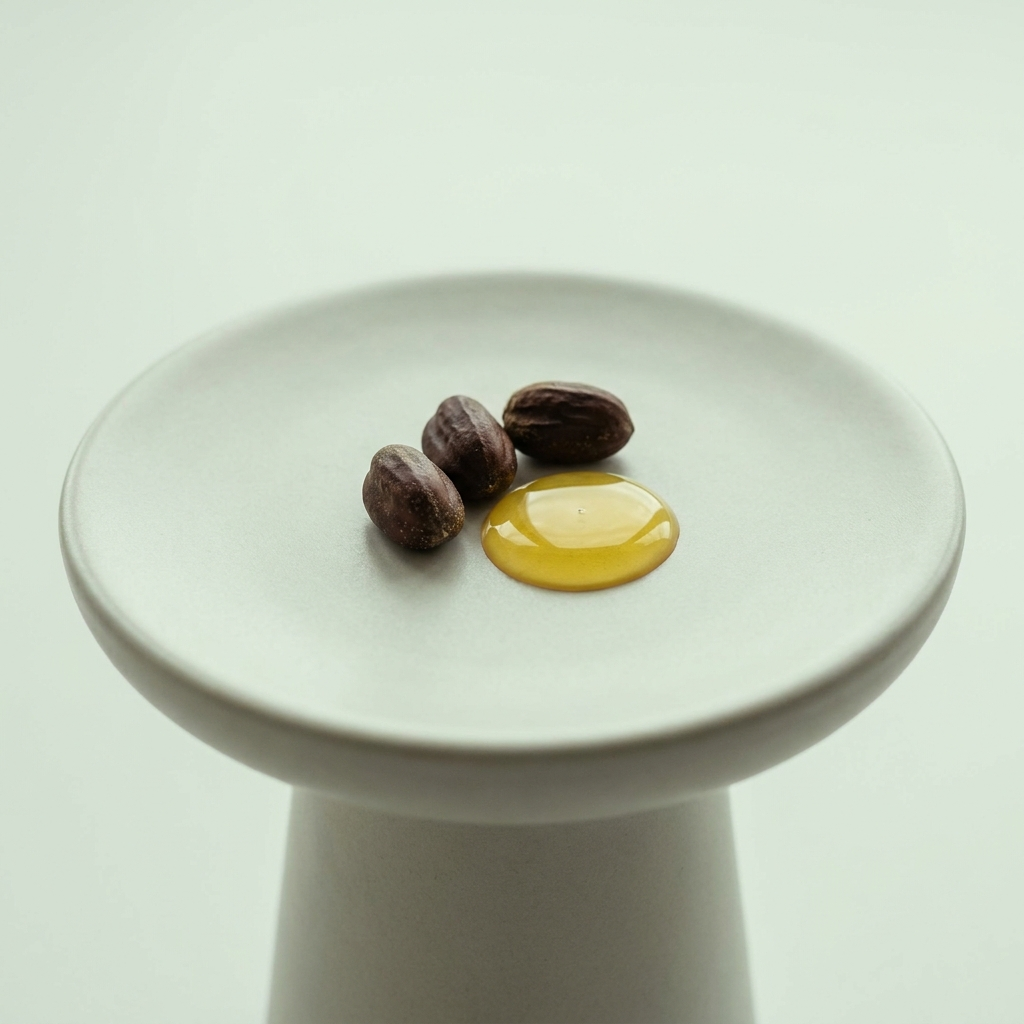
Active Ingredients Glossary · J
INCI: Simmondsia Chinensis Seed Oil
Jojoba oil is misnamed: Chemically speaking, it isn't an oil at all, but a liquid wax—and that's exactly what makes it so special. Its structure resembles the skin's own sebum, which is why it absorbs without leaving a greasy film. An all-around solution for skin, hair, and scalp.
What is jojoba oil?
Jojoba oil is extracted from the seeds of the jojoba shrub, which grows in the deserts of North America. The key difference from traditional plant oils is that jojoba oil consists not of triglycerides, but of liquid wax esters. This structure is closer to the skin's own sebum than virtually any other plant oil—the skin, so to speak, is already "familiar" with this substance.
This results in two practical advantages: First, jojoba oil absorbs quickly and leaves the skin feeling silky rather than oily. Second, it is exceptionally stable—it hardly oxidizes and does not go rancid, which is why it also serves as a carrier oil for more sensitive active ingredients in many formulations. In hair oils such as the HAIR SYRUPs, it fulfills precisely this role: a lightweight carrier that nourishes without weighing the hair down.
Effect: What's Been Proven
Three out of five bars: The wax ester structure and high stability of jojoba oil are well documented scientifically, and it is established as an emollient—that is, a skin-softening lipid. Smaller studies and application tests show that jojoba oil smooths the skin, can slow moisture loss, and is exceptionally well-tolerated—even on combination skin, as it is considered to be non-comedogenic. However, large, independent clinical studies are lacking. To be honest: a proven, straightforward base skincare lipid—more craftsmanship than high-tech.
Usage & Combination
On the skin, jojoba oil works both in the morning and at night—used undiluted in small amounts or as an ingredient in cleansers, body oils, and creams. For hair, it shines as a pre-wash treatment: massage it into the lengths and scalp before washing, let it sit, then rinse thoroughly. Because it's so light, it's also suitable for fine hair.
Pairs well with
✓ Hyaluronic acid – moisturize first, then use jojoba as a light sealant
✓ Macadamia & argan oil – jojoba makes richer oils lighter
✓ Essential oils – as a stable carrier oil, for example with lavender for the scalp
Note
! Quality matters: cold-pressed, unrefined oil (if possible) retains the most natural compounds
! Allergic reactions are very rare—test new products on the inner elbow first
Jojoba Oil in the BONSANA Line
Shop Now
Discover hair oils with jojoba
Pre-wash oils and hair treatments with lightweight nourishing oils—shipped from our Swiss warehouse, delivered quickly to you.
Go to Hair Oils & Hair Treatments →Frequently Asked Questions About Jojoba Oil
Why is it called oil when it's actually a wax?
Because it's liquid at room temperature and can be applied like an oil. Chemically, however, jojoba oil consists of wax esters rather than triglycerides—hence its exceptional stability and similarity to the skin's own sebum.
Is jojoba oil suitable for blemish-prone skin?
Jojoba oil is considered to be minimally pore-clogging and is therefore one of the few skincare lipids that often works well even on combination skin. As always, introduce new products gradually and monitor your skin's reaction.
How do I use jojoba oil on my hair?
The easiest way is as a pre-wash: massage it into the lengths and scalp 15 to 60 minutes before washing, then shampoo twice. As a light carrier oil, it barely weighs down even fine hair.
Does jojoba oil go rancid?
Hardly ever—thanks to its wax ester structure, jojoba oil has a significantly longer shelf life than most plant oils. When stored in a cool, dark place, it generally lasts for years.


